Beyond the Int16 Overflow: Recovering the Match Hi-Rez Drops
One broken skin can truncate a match response and leave the result incomplete or unavailable. PaladinsCat treats that failure as recoverable evidence.
Published: July 2026 | Topic: API resilience · Match recovery · Data provenance
From a known bug to a working recovery system
Our first Int16 overflow post documented the numeric boundary behind broken Paladins skin data. Skin IDs now exceed the signed 16-bit maximum of 32,767, but part of the Hi-Rez match-data path still attempts to read the value as an Int16.
The boundary itself was not a new discovery. The issue had been known for more than five years. The breakthrough that started PaladinsCat development in May 2026 was understanding how the failure disrupts raw match responses—and building a system that reconstructs complete results from incomplete or failed data.
This post follows that failure from the raw Hi-Rez payload to the final PaladinsCat scoreboard.
What the raw API response looks like
The practical failure appears in the raw match-details response. Player data is processed in order. When the API reaches a player using an affected skin, it returns an Int16 error; earlier rows may survive as a valid prefix while the affected row and everything after it is dropped:
[
  {
    "Match": 1280822548,
    "TaskForce": 1,
    "playerId": "<valid player ID>",
    "SkinId": "<valid skin ID>",
    "ret_msg": null
  },
  {
    "...": "four more valid Team 1 player rows"
  },
  {
    "Match": 1280822548,
    "playerId": 0,
    "SkinId": "<value above 32767>",
    "ret_msg": "Value was either too large or too small for an Int16. Failing Field = skin_id"
  }
]
[!NOTE] This is an abridged representation of the response shape. Repeated player statistics and unrelated fields are omitted; the
ret_msgtext is preserved exactly.
This is not a normal HTTP failure with a clean error status. Valid player objects and an application-level ret_msg can arrive in the same response. A consumer must understand both the order and the incompleteness of the payload.
The surviving fragment is not fixed. The failure can occur at any player position, leaving anywhere from zero to nine usable rows before the affected row and everything after it is dropped. The cases below are observed examples, not the only possible response shapes.
Observed Example: Broken Skin in Player Position Six
The response stops being useful at the broken row. If the affected skin appears in player position six—the first slot on Team 2—the API has already emitted the five Team 1 players. The broken sixth row becomes the sentinel, and the remaining Team 2 rows never arrive.
That exact shape is visible for match 1280822548:
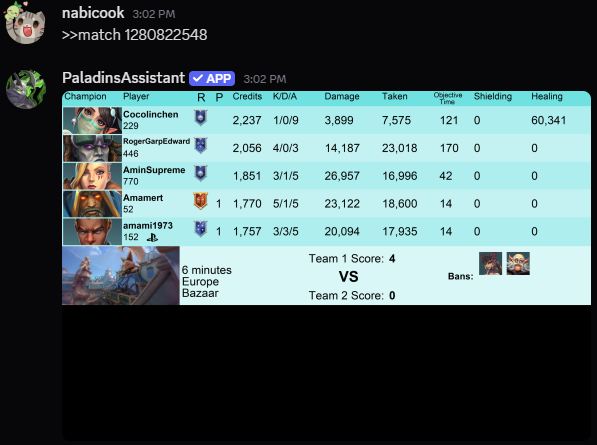
PaladinsAssistant displays the five-player prefix. Team 2 is absent after the broken skin occupies the sixth player position.
Returning five valid rows is especially dangerous because the payload looks partially successful. A client that only checks whether the array is non-empty can render half a scoreboard without realizing that the other team was dropped.
Observed Example: Broken Skin in Player Position One
The more extreme failure happens when the affected skin belongs to the first player in the ordered payload. The serializer fails before it emits a single valid player row:
[
  {
    "Match": 1280790711,
    "playerId": 0,
    "SkinId": "<value above 32767>",
    "ret_msg": "Value was either too large or too small for an Int16. Failing Field = skin_id"
  }
]
There is no healthy prefix to preserve. The first player becomes the error sentinel, the other nine players are never emitted, and all ten player rows disappear from the direct result. Consumers that expect a normal scoreboard receive an API error or treat the match as missing.
How the failure appears to players
The examples below show the extreme first-position failure for match 1280790711: the broken skin is encountered before any valid player row, so the direct payload loses all ten players. Different consumers surface that same upstream failure in different ways. These screenshots are not presented as criticism of the services involved; they document the user-visible outcomes of the failed Hi-Rez response.
Generic command failure
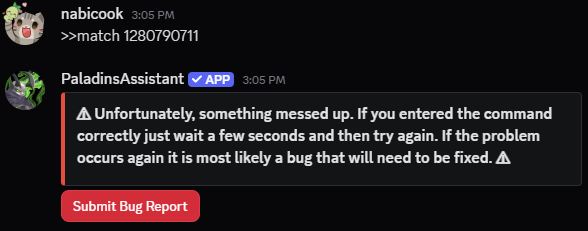
PaladinsAssistant cannot render match 1280790711 and returns a generic retry or bug message.
Explicit broken-skin error
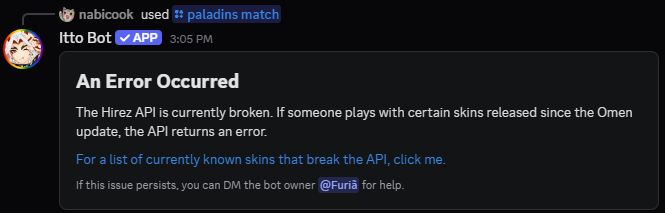
Itto Bot recognizes the affected-skin condition but still cannot provide the match result.
Match not found
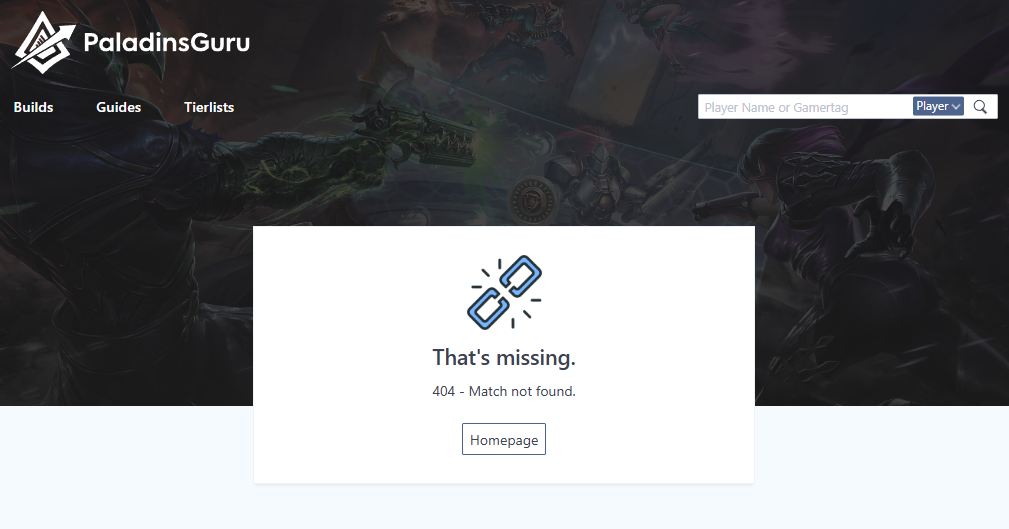
Paladins.guru surfaces the failed upstream result as “404 — Match not found.”
The visible outcomes differ, but the lost information is the same: the player cannot inspect the complete match.
Failure and Recovery Flow
PaladinsCat treats the Hi-Rez error and any surviving player rows as a damaged evidence set—not as proof that the whole match is unusable. At a public level, recovery follows this flow:
flowchart TD
    A["Receive match response"] --> B{"Complete and usable?"}
    B -->|Yes| C["Publish standard match result"]
    B -->|No| D["Classify match as broken"]
    D --> E["Preserve usable evidence"]
    E --> F["Gather independent match evidence"]
    F --> G["Reconstruct missing records"]
    G --> H{"Recovery validation passes?"}
    H -->|Yes| I["Publish recovered result<br/>with source labels"]
    H -->|No| J["Retain limited result<br/>with recovery state visible"]
[!NOTE] This diagram describes PaladinsCat's public recovery behavior. Internal endpoints, lookup order, storage layers, and validation rules are intentionally omitted.
Match Health and Provenance Legend
Match health tags describe the condition of the result. Provenance labels describe where individual player records came from. The two are separate and may appear together.
Match Health Tags
Player-Row Provenance
| Label | Public meaning |
|---|
A Limited match may contain minimal player records, but a health tag and a provenance label are not interchangeable.
Direct evidence and recovered evidence working together
Match 1280822548 demonstrates the mixed-source path:
- The external partial result shows only five players.
- PaladinsCat publishes all ten authoritative player rows.
- Five surviving rows retain
source=direct. - Five missing rows are restored with
source=recovered. - The match remains labeled
broken=trueandrecovered=true, so the repair is visible rather than hidden.
Match 1280790711 demonstrates full reconstruction after the first-position failure. Because the broken skin appears before any valid direct row, all ten players must be recovered. Its live PaladinsCat result contains ten authoritative rows with source=recovered and retains two confirmed-cheater account tags that would otherwise be hidden behind an API error or missing-match page.
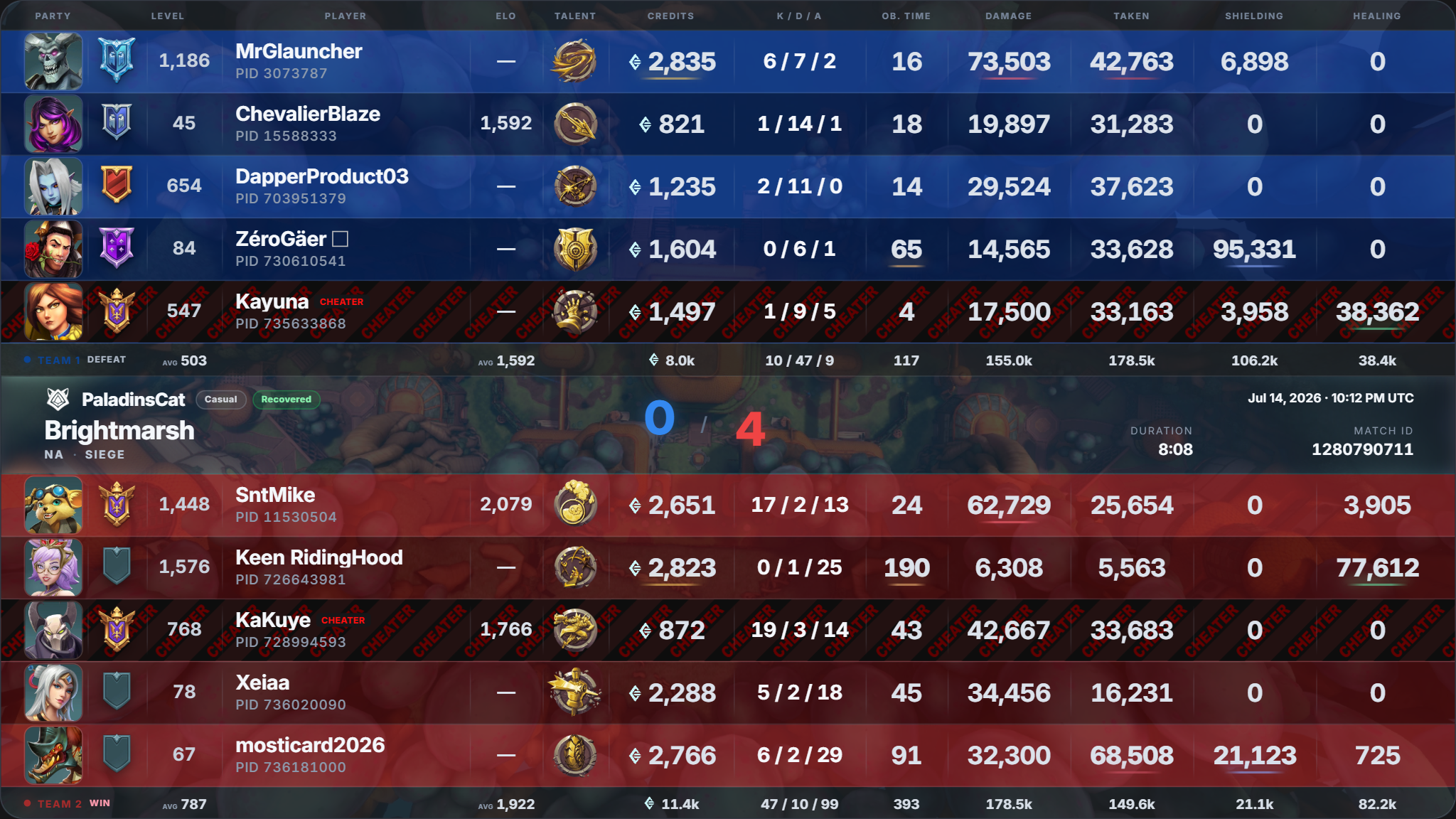
PaladinsCat publishes the complete scoreboard for match 1280790711, labels it Recovered, and retains account-level evidence on the affected player rows.
[!IMPORTANT] Account tags shown here reflect PaladinsCat's confirmed status at the time of capture. They provide data-driven community evidence and do not replace official moderation or independent review.
Why this is the breakthrough
The breakthrough is not the discovery that 32,767 is the Int16 limit. It is recognizing that the Hi-Rez response before the sentinel is still valuable, that the absent rows can be reconstructed from independent match evidence, and that direct and recovered facts must remain distinguishable.
The consolidated flow above turns a long-standing upstream failure into a transparent data-quality state. For players, the difference is simple: instead of an error, half a team, or a 404, they receive a complete scoreboard with visible provenance and evidence that remains available for community review.
Screenshots and match-status observations were captured on July 16, 2026. Third-party interfaces and account statuses may change after publication.